
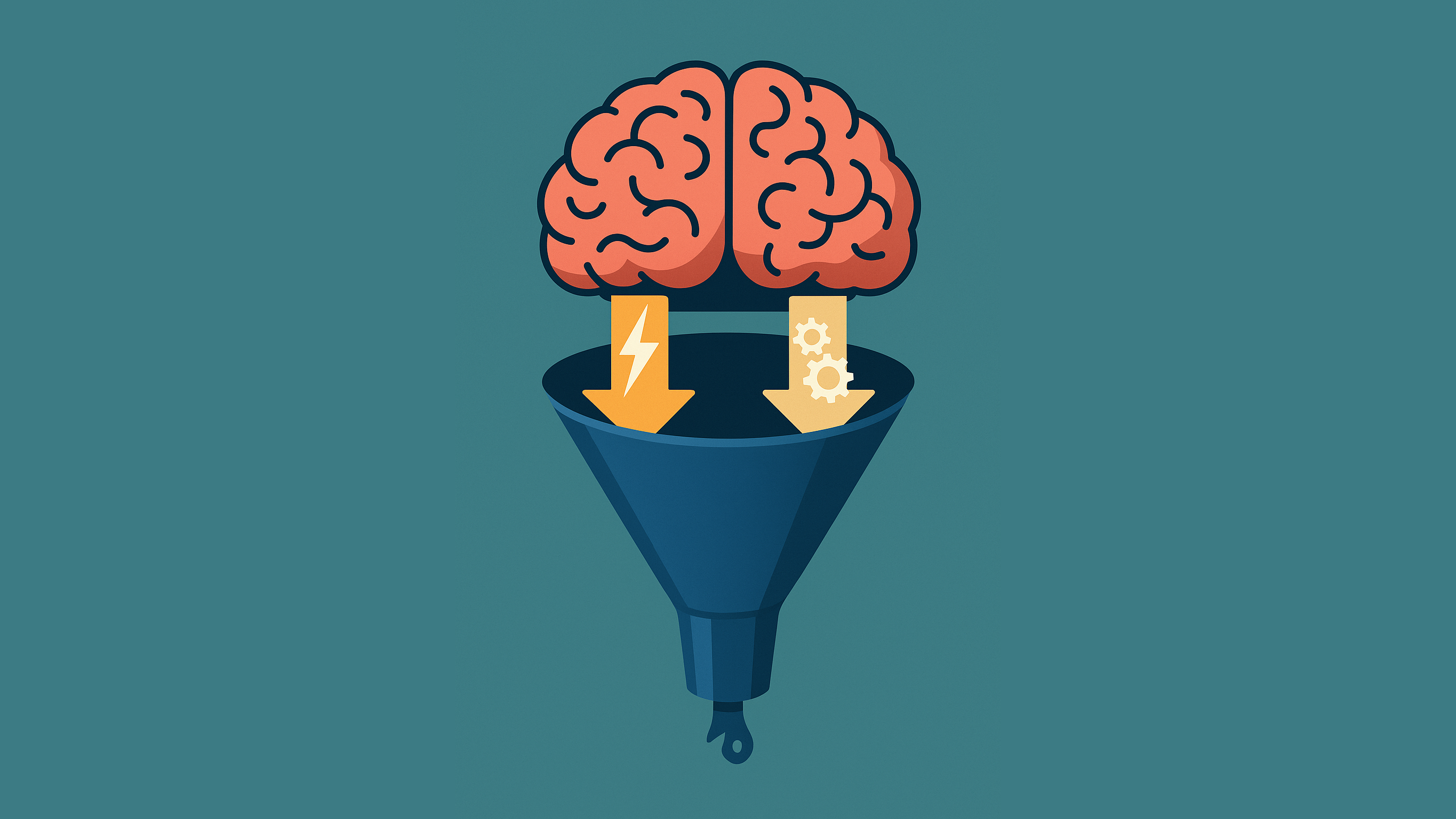
Despite your best intentions, buyers are slipping out of your funnel. The good news? You can fix your funnel with psychology and stop losing them.
Marketers often focus on fixing the obvious problems like broken links, low open rates, or disconnected landing pages. But these are just symptoms. The real leaks stem from a mismatch between the way people think and decide and your marketing messages.
To plug the gaps and optimise conversions, you need to understand the cognitive journey your audience takes. That means learning how System 1 and System 2 thinking affect the way people process information and make decisions and incorporating that into your messages.
Meet the two minds that guide every decision
Think about how you make decisions. Are you rational and deliberate? Or do you act instinct and emotion?
No matter how you answer the question, Nobel Prize-winning psychologist Daniel Kahneman would argue that everyone is both.
Kahneman says human are governed by a dual track of thinking systems:
- System 1 is fast, emotional, automatic, and subconscious.
- System 2 is slow, analytical, methodical, and conscious.
The problem is that most marketers build funnels for System 2. They assume buyers will carefully weigh options, read every word in their brand-optimised emails, and follow logical paths to conversion.
But in reality, most decisions are made in System 1. They’re quick, intuitive, and based on gut feelings.
That’s why your perfectly reasoned funnel might not convert. It doesn’t reflect how people behave.
Fix your funnel with psychology: Hidden friction points
System 1 hates friction. If something feels confusing, overwhelming, or difficult, we back out, often without knowing why. These are some psychological red flags that might propel your customers out of your funnel:
- Too many choices. This leads to decision fatigue and abandonment.
- Jargon-heavy copy. If System 1 thinkers have to slow down to understand what you’re saying, they’ll escape for something less cognitively taxing.
- Unclear CTAs. This can make people hesitate, which increases drop-off.
- Inconsistent design. People prefer the familiar and consistent. Inconsistent design disrupts fluency and trust.
Each of these triggers extra mental effort, which kicks decisions up to System 2. That’s the point where many users simply opt out.
5 psychological tactics to smooth the journey
To optimise your funnel, design for System 1 while supporting System 2. It’s not as hard as you might think!
1. Use mental shortcuts (Heuristics)
Known to psychologists as mental shortcuts, these are devices that help people make decisions quickly. They include:
- Social proof: Getting approval from others. Example: “Join 20,000 marketers already using this technique.”
- Authority: You emphasize your experience and knowledge. Example: “With over 26 years of expertise …”
- Scarcity: It can make something more desirable. See also: “Fear of missing out.” Example: “Only 4 seats left!”
- Anchoring: People use the first information you present to judge your sales value. Example: “Normally $299, now only $149!”
2. Simplify with defaults
Defaults reduce the cognitive load your customers face when they have to fill out forms, compare plans, or select options. In your email messages you can make your most popular products or plans the default option.
On your landing pages, pull in the data you have on your customers to load data into forms. As you did in your emails, you can present your most popular products, or products that match browse data, as the default option. Aim for one-click choices instead of extreme customisation.
3. Design for fluency
Complicated email message layouts with multiple fonts, clashing colors, and densely packed copy blocks are hard to read, especially on mobile screens. Readers have to work harder to grasp your messages. That makes them more likely to move to the next one instead of acting on yours.
Aim for a clean format that uses white space to set off important areas like your primary message or call to action. Use a visual hierarchy that guides your reader smoothly through the message and design tools that subtly direct the eye to your key information.
The easier your subscribers can read or interpret your emails, the more trustworthy they will be.
4. Anticipate objections early
This is an essential step if you market more expensive or complex products or services. Your emails can focus purchasing advice or user tips to reduce uncertainty and encourage clicking.
On the landing page, use strategically placed micro-copy and FAQs to, tool tips, or short FAQ answers to answer more questions and build confidence. This keeps users in System 1 thinking and moving forward.
5. Create emotional momentum
The best emails don’t sell. They tell stories that use benefit-focused copy and arresting visuals to tap into the positive emotions (pride, excitement, satisfaction, relief) that your products or services can produce or reduce negative emotions like anxiety.
Example: Early in the buying journey, send emails that show customers what success looks like when they use your product or service. This gets fast buy-in from System 1 before System 2 and its logic kicks in.
From theory to conversion: Applying psychology across the funnel
Every tactic of your email strategy—subject lines, copy, design, landing pages, confirmation messages, follow-up communications—can benefit from these insights. By addressing both minds, you create an experience that feels right (System 1) and makes sense (System 2).
Too many marketers force their audience to think too much, ask too many questions, or feel uncertain. That’s when they lose them.
You don’t need to rewire your entire email strategy. You just need to understand how people think and build with that in mind.
Want to learn how to fix your funnel with psychology at every touchpoint?
Our self-paced course The Buyer’s Mind shows you how to:
- Reduce cognitive friction
- Apply psychology to every stage of the funnel
- Increase conversion with subtle, science-backed tweaks
The course is CPD certified
It’s completely free
Join the waitlist today to be the first to know when it launches.
Remember, better tools won’t save you if you don’t understand buyer behaviour. Start by learning how to fix your funnel with psychology.
